Ultrasound QA Baseline Drift: Triage Before You Repair
Same symptom on your system?
Tell us your model and what it is doing. A GEPROBE engineer replies with a diagnosis path, part options and pricing — usually within 6 hours, with no obligation.
Chat on WhatsApp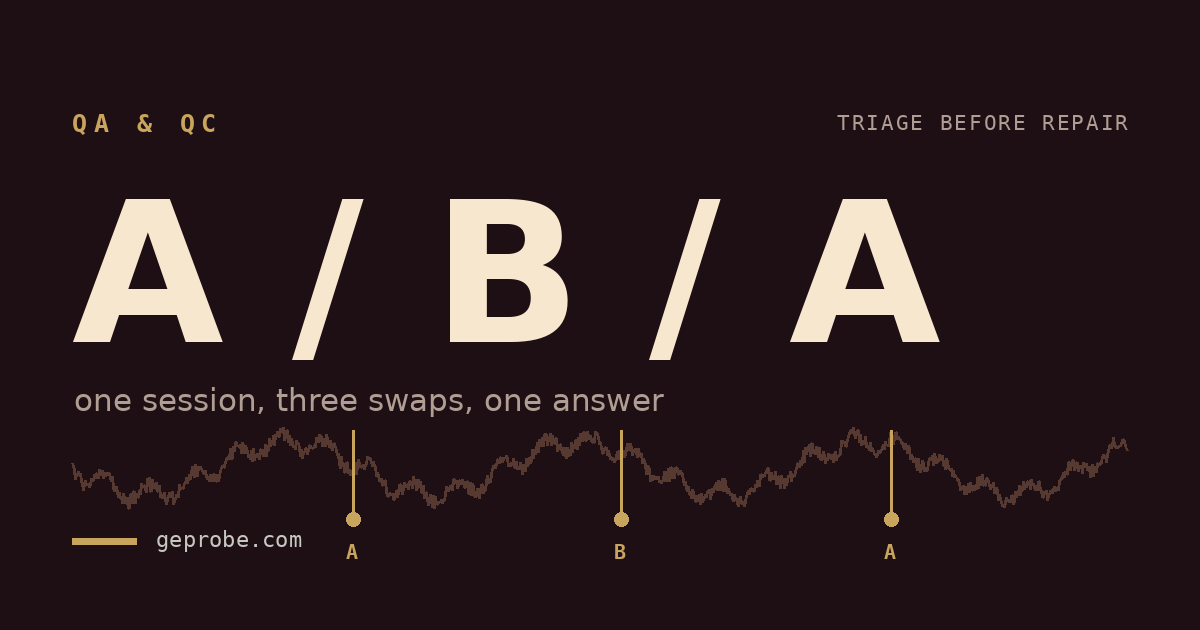
Most ultrasound QA baseline drift is not a repair order. It is a reference object, a setting, or a hand that moved — and a plain worksheet cannot tell you which one.
This page works the problem the other way round. You measure how repeatable the test is, you run one session that localizes the fault, and you price the decision before anyone buys a transducer.
Measure the Test Before You Measure the Drift
Every QA number has its own spread. Five caliper placements on the same target, same probe, same preset, same day, will not agree to the millimetre.
Measure that spread first. If your drift is the same size as your repeatability, you are investigating noise.
A short range-chart shortcut works with five repeats. The d2 constant for n = 5 is 2.33 in the standard range-chart tables, so an estimate of the standard deviation is the observed range divided by 2.33.
Then treat a change as a finding only when it clears two of those standard deviations. Below that, log it and keep trending.
σ̂ = (max − min) ÷ 2.33, n = 5. Finding if |Δ| ≥ 2σ̂. Investigate technique if |Δ| < 2σ̂.
Once you have that floor, two things change. You stop re-opening probes over noise, and you can finally claim a real shift with a number behind it.
If the floor itself is wide, fix the test before you touch the equipment. Coupling, target registration, and hand pressure are the usual culprits.
A test that cannot repeat inside a stated band also cannot detect a drift smaller than that band. That is a property of your worksheet, not of your scanner.
One Session, Three Swaps, One Answer
The efficient design is A/B/A. You capture A, change one element, capture B, then return to A before the next swap.
The return leg matters more than the swap. If A does not come back to itself, the rig moved and every comparison after it is worthless.
Three swaps cover the three candidates: a second documented reference, a known-good replacement probe of the same type, and a second approved port.
| Pattern across the A/B/A runs | What it localizes | Next move |
|---|---|---|
| Fault persists on both references, probe unchanged | Reference condition or technique | Withdraw the reference, verify its condition, re-train the placement |
| Fault travels with the probe across ports and references | Probe | Probe evaluation on a bench, not a scanner swap |
| Fault stays on one port with both probes | Console or channel path | Console diagnostics, then board-level scope |
| Fault appears only when one named setting differs | Acquisition or baseline mismatch | Correct the recorded settings, re-run A |
| Fault vanishes on the return leg with nothing changed | Repeatability or coupling | Raise the repeat count before any escalation |
Keep the first abnormal run even when the return leg is clean. A clean repeat is a second data point, not an erasure.
Price the Decision Before Anyone Orders a Part
Verification has a cost and so does being wrong. Compare them instead of arguing about confidence.
Let p be the chance that the drift sits in the reference, the setup, or the operator rather than the hardware. Let C_wrong be what a wrong component decision costs you in total. Let C_verify be one controlled session.
Verify if p × C_wrong > C_verify. Break-even p* = C_verify ÷ C_wrong.
Take an illustrative case, with invented rates. C_verify = $220: three technologist hours at $60 plus a $40 bench slot. C_wrong = $6,500 for a refurbished compatible probe plus the repeat QA after the fault returns.
Then p* = 220 ÷ 6,500 ≈ 3.4%. Verify whenever there is more than a one-in-thirty chance the fault is not in the probe. In practice that is almost always.
The arithmetic also prices the reference.
Swap the phantom only when its own condition test fails. Sun Nuclear ties advanced desiccation to a sunken membrane, imaging artifacts, or weight loss close to 1% of phantom weight (Sun Nuclear FAQ, reviewed 2026-11-14).
A reference that disagrees with one probe has not failed. A reference that has lost its water has.
There is a second cost that rarely gets counted. Resetting the baseline after a wrong diagnosis destroys the trend you would need to catch the next drift.
What a Clean Phantom Image Cannot Prove
This is where phantom verification before probe repair gets oversold. A tidy uniformity image is weak evidence of a healthy transducer.
Vuorenmaa and colleagues ran three QA methods over 99 clinical transducers in two Finnish hospitals. The electronic element test classified 31% as defective.
Within the 37-probe subgroup that received all three methods, the sensitivity test and the in-air test each flagged 27%.
The phantom uniformity test flagged 14%, and the three methods agreed on 78% of the group (Springer, JMBE 2025, reviewed 2026-11-14).
The authors' own conclusion is the useful part: a uniformity test needs a phantom and can confirm a defect the other methods found. It is a confirmer, not a screen.
There is a physical reason too. The CIRS instructions for the 040GSE note that slice thickness is typically much coarser than axial and lateral resolution.
That same guide says a full characterisation of resolution requires measuring elevational resolution, meaning slice thickness, as its own quantity (CIRS 040GSE guide, reviewed 2026-11-14).
So a single-plane uniformity view cannot stand in for elevational behaviour. Never close a clinical complaint with a passing phantom image.
Scheduling One Phantom Across a Department
One reference, nine probes, and a monthly intention is a capacity problem before it is a clinical one.
Interval in days ≈ 30 × (available session minutes per month) ÷ (minutes per probe × probes).
At 180 available minutes, 25 minutes per probe, and nine probes, you get 30 × 180 ÷ 225 = 24 days. A nominal monthly cycle with six days of slack absorbs one cancelled session and no more.
Two rules follow. Rank probes by clinical exposure — the transesophageal and endocavity units usually lead — and recover a missed pass on the riskiest probe, never on the easiest one.
If the required interval keeps landing under your minimum, the answer is a second reference or a shorter protocol, not a longer working day.
Put the pass in the same calendar as the physics survey, not in a separate one. Two schedules drift apart, and the reference is the first thing to be skipped when a list gets long.
The Evidence Pack a Bench Can Quote From
A repair enquiry that arrives with a localized fault gets scoped. One that arrives with "image looks worse" gets a request for more information.
Send the A/B/A table, the settings snapshot, the probe identity, and the reference's condition. Mark fields you could not obtain as unknown rather than blank.
Then state the question. Diagnosis, repair, or replacement are three different jobs with three different prices, and a bench can only answer the one you asked.
For the repair route, see probe repair. If the finding is a system-side fault, or you need a like-for-like replacement instead, the ultrasound parts catalog is the faster path.
Do not send patient images. Non-patient test captures and equipment identifiers are sufficient for a scope.
Unknown is a value. A blank field reads as a passed check when the file is reviewed six months later, so write "not obtained" and say why.
One more field earns its space: whether the fault is intermittent. A drift that only appears after twenty minutes of scanning sends a bench down a different path than a constant offset.
Return-to-Service Checklist After Any Intervention
Whether you swapped a probe, replaced a board, or replaced the reference, the same gate applies. Nothing goes back to clinical use until every line holds.
| Gate | Pass condition | What goes in the record |
|---|---|---|
| Reference condition | Current weight and surface inspected against the certificate | Weight, date, inspector |
| Settings parity | Preset, depth, gain, TGC, focus and processing match the baseline snapshot | Screenshot or exported settings |
| Repeat completed | At least two A runs on the return leg | Both images, both measurements |
| Delta quantified | Change expressed in millimetres and percent of expected distance | Value plus σ̂ from the noise floor |
| Action level applied | Facility limit named, and the result compared to it explicitly | Limit, verdict, reviewer |
| Baseline decision | Either the old baseline is retained with a note, or a new one is approved and dated | Decision, approver, effective date |
| Record retention | First abnormal run kept alongside the corrected result | Record identifier |
ACR accreditation asks for documentation of corrective action when QC data identifies a performance problem, and treats acceptance testing as optional but recommends it (ACR QC guidance, revised 2025-04-09, reviewed 2026-11-14).
Note what the ACR does not do: it does not set your drift limit. That number is yours to define and defend.
AIUM's routine QA guide for clinical ultrasound equipment is the other document most programmes cite.
It ships through the member resource library (AIUM resource library, reviewed 2026-11-14), so read the interval wording from your own copy rather than from a summary.
The classic caliper criteria still come from AAPM Report No. 65, the Task Group No. 1 QC procedures by Goodsitt and colleagues (AAPM Report 65, reviewed 2026-11-14). Verify any quoted threshold against the table itself.
The Order of Operations
Noise floor first. A/B/A second. Arithmetic third. Hardware last.
A drift that survives all four steps is a real finding with a defensible paper trail behind it. A drift that dies at step one just saved you a transducer.
Sources
- AIUM resource library — reviewed 2026-11-14. Holds the AIUM routine QA guide, version 2.0; member access required.
- ACR quality control article for ultrasound and breast ultrasound — revised 2025-04-09, reviewed 2026-11-14.
- AAPM Report 65, TG-1 QC procedures — reviewed 2026-11-14. Goodsitt et al., Medical Physics 25 (1998).
- Vuorenmaa et al. 2025, three-method comparison — reviewed 2026-11-14. Open access in JMBE.
- CIRS 040GSE user guide — reviewed 2026-11-14. Distributor-hosted copy of the manual.
- Sun Nuclear ultrasound FAQ — reviewed 2026-11-14.
- GEPROBE probe repair and ultrasound parts — reviewed 2026-11-14.
Dollar figures and the 25-minute session estimate in this article are illustrative, not quoted rates.
Related Articles
Qualifying a Refurbished Ultrasound Parts Supplier
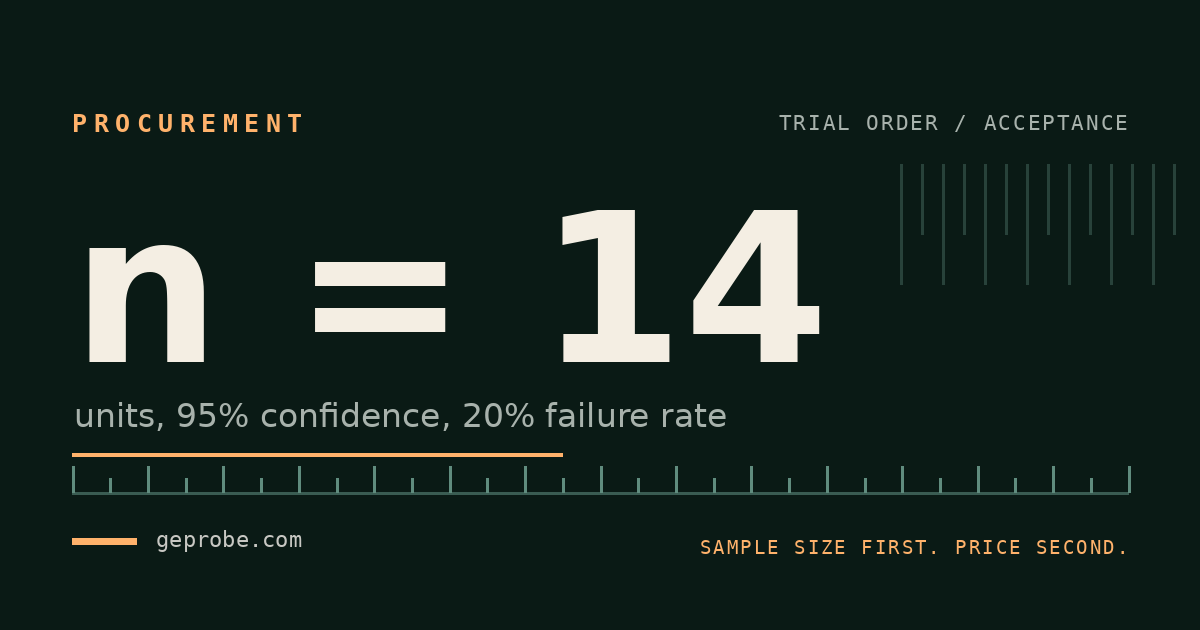
Sample size, landed cost, response clocks and a repair ceiling: the arithmetic to run before a refurbished ultrasound parts trial order.
Used Ultrasound Export UK: Prove Equipment, Not Waste
How to prove a used ultrasound is equipment rather than waste on a used ultrasound export UK shipment, with the probe-level evidence most files miss.
DICOM Photometric Interpretation vs. Color Doppler in PACS
Color Doppler that looks wrong in PACS is usually an encoding question, not a probe fault. A four-point check, a ship gate, and the arithmetic.